An Insider Approach to Designing for Neurodivergent Learners (and How it Benefits Everyone)
An Insider Approach to Designing for Neurodivergent Learners (and How it Benefits Everyone)—a webinar I gave for ELB Learning—is now live on YouTube!
This was an action-packed hour, and I didn’t have time to answer all the questions this super involved group came up with, so the amazing Kasey May followed up with me and made sure all the attendees received answers to their questions.
And now I’m making sure everyone else can have those answers, as well.
If you weren’t able to attend, here’s the video…
And here is the followup Q&A…
Q: Is this webinar designed with neurodiverse learners in mind (beyond traditional experience design)?
A: I believe so! I’ve worked hard to apply the principles I’m teaching, as well as other accessibility guidelines, such as color contrast, etc. (Note: I would use neurodivergent instead of neurodiverse here. I haven’t written about that publicly much, but I will soon.)
Q: Have you tried using AI tools to create learning that recognizes neurodiversity?
A: Well, I have thoughts about GenAI, and I’ve written about them recently on my website and LinkedIn. And I just recorded a webinar with Betty Dannewitz and Tim Slade, so watch for that in July… and I have another article coming soon that will focus more on some of the benefits and harms that I see happening specifically with neurodivergents.
What I don’t see happening right now is much improvement in accessibility with GenAI-generated content and vibe-coded apps and websites… in fact, we’re seeing the opposite. I’ve definitely not seen any examples in which improvements were made by telling the tool, “make this neuroaccessible.” But, if you know how to make eLearning neuroaccessible by applying the guidelines we discussed, you might be able to get tools to make specific improvements, such as “add breadcrumbs,” “make the sentences shorter,” etc.
Q: How do you balance flexibility with getting clean scoring and metrics data? Analytics is so important to eLearning users for measuring their learners’ improvement and advocating for more L&D funding that it’s hard to tell how much variance we can allow before the data becomes “apples to oranges”.
A: Make the results the primary focus of your data, not the journey your learners took to get there. How long someone took to complete a course or how many times they clicked don’t matter; proficiency, skill-building, and performance do.
Q: I notice you’re generally using identity-first language (“Autistic”) vs. person-first language (“person with Autism”). Why is that?
A: Great question, thanks for noticing! I wish I had time to include so many things in this session, but this is an issue of inclusion rather than accessibility, so I usually don’t.
As a whole, autistic adults in the US (and England, I believe) prefer identity-first language. I delve into the reasons in this article, but at its core, it’s just a matter of using the preference of the majority.
If someone tells me they prefer person-first language, I use it for them. My son does, and that’s okay! But when that’s unknown, like with writing and speaking to the public, I use what the large majority has expressed that we prefer.
Q: How do you deal with DEI people who focus on racism but say that psychological safety and disability are “not real”? To add insult to injury, these people work in HR…
A: Oh my. Are you open to all suggestions, or only legal ones? (Just kidding!)
First of all, it’s very clear that disability is real. Many disabilities are literally visible. Neurodivergence is usually not. I’m hoping there’s a typo here and you meant to say “neurodivergence” instead of “disability.” Because I genuinely don’t know what to say to someone who would pretend someone’s wheelchair or service dog doesn’t exist.
Either way, it kinda sounds like this person doesn’t believe that psychology is valid, which is incredibly unfortunate for many reasons, not the least of which is that psychological safety is also an important part of anti-racism DEI work.
If they’re set in those beliefs, I don’t know if they will be convinced by anything, but the big brains have done quite a bit of science on psychological safety, actually, so you might go into the conversation armed with information from studies such as this one. (Hot tip: Always email the person who did the study before paying for it; they want their work out in the world and they’ll probably send it to you for free.)
Studies like that are important to know as background, but to be honest, people are usually convinced by relationships and stories more than by data and facts, so I might try to have some dialogue with them to find common ground, then work some things into the conversation that they can relate to.
They may not believe in psychological safety as a concept, but they can probably relate to something like, “I had a boss at a previous job who was so hot-and-cold that I could never get comfortable, and I eventually spent more time trying to figure out what they wanted than I did getting work done.”
Or, since they are interested in anti-racism DEI work, it might be something like, “The disparity in job losses for Black women since the pandemic is really troubling… I bet that takes an extra toll on those who are still employed, but may feel even more like they can never mess up at work.”
And then the conversation goes on from there. Don’t make it sound like an after-school special, though. You’ve got this!
Q: Can you talk about what you mean by ‘meaningful visuals’?
A: Sure! You may have noticed that I didn’t have a ton of visuals in my presentation, but I tried to make them something that illustrated concepts. For example, this image…

…shows the learners looking into bright lights, and it’s meant to make you feel like people are close together, which might be an issue for someone who gets distracted by scents and a lack of personal space.
Here’s another one that I often use to illustrate neurodivergence vs. neurodiversity.
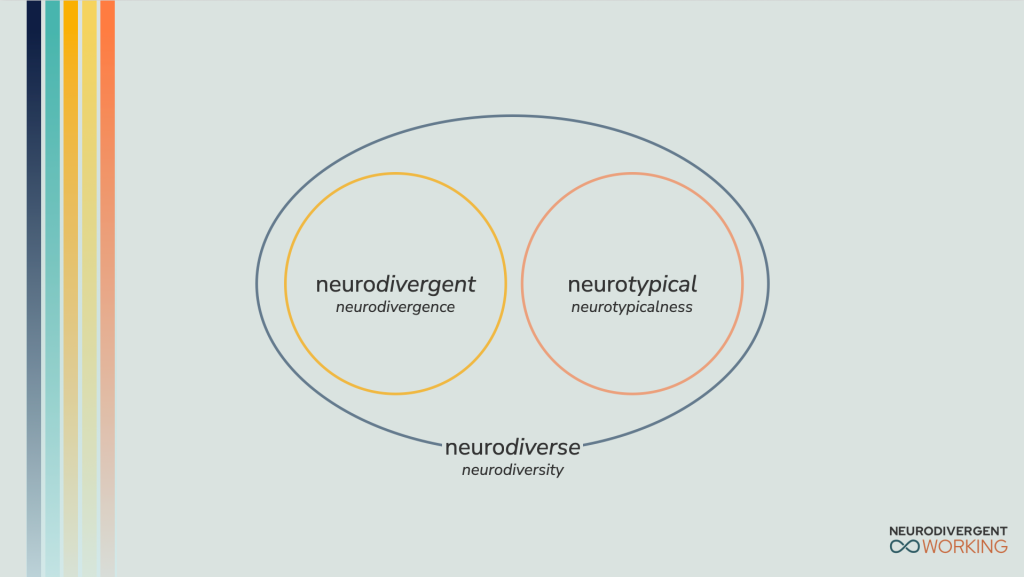
These visuals create mental hooks upon which we can add meaning, give us a feeling about a concept, maybe even illustrate the basic meaning of a concept, all on their own.
On the other hand, visuals that only decorate can be distracting, especially if they’re overdone. I think I mentioned screen beans… if you weren’t around for those, here’s an example. They were around about the same time as Word Art.

What were we doing with those??? They were cute for like 30 seconds, and we used them for about ten years.
Q: What is meant by elearning being “too linear”?
Not all elearning is too linear, but some is. Something that’s linear forces people in one direction rather than letting them explore. So it may make people go from topic A to topic B, etc. Less linear approaches might put your learners in scenarios they can’t necessarily solve and give them access to information they can find on their own.
The reason for this is that while topic A, topic B, etc., may be logical to one brain, it’s not necessarily the same for all brains. And many neurodivergents (particularly autistics) are bottom-up processors… we like to construct meaning from the details rather than from abstract principles and instructions.
And many learners, ND and NT alike, benefit from pulling the information in response to a need (e.g., I can’t solve this scenario unless I learn something about the HIPAA Privacy Rule). So it’s really good for everyone.
ILT is linear by nature (because that’s how time works), but at least you can ask a trainer to repeat something you missed or explain something a different way. With elearning, if you don’t have the ability to jump around a bit, you might have to redo the whole course to understand.
Q: Is it appropriate to ask people if they need/want specific accommodations (e.g., include something in an email or description to contact for additional service/requirements)?
A: I love that for removing barriers for all kinds of disabilities!
Q: My only question is, will you do another session on this?
For sure, that’s what I do! This topic isn’t one I usually cover for the public, so the ELB Learning session was super special. And this session has grown so much that it’s likely to be expanded in my course catalog soon.
Feel free to reach out: judy at neurodivergentworking dot com.